
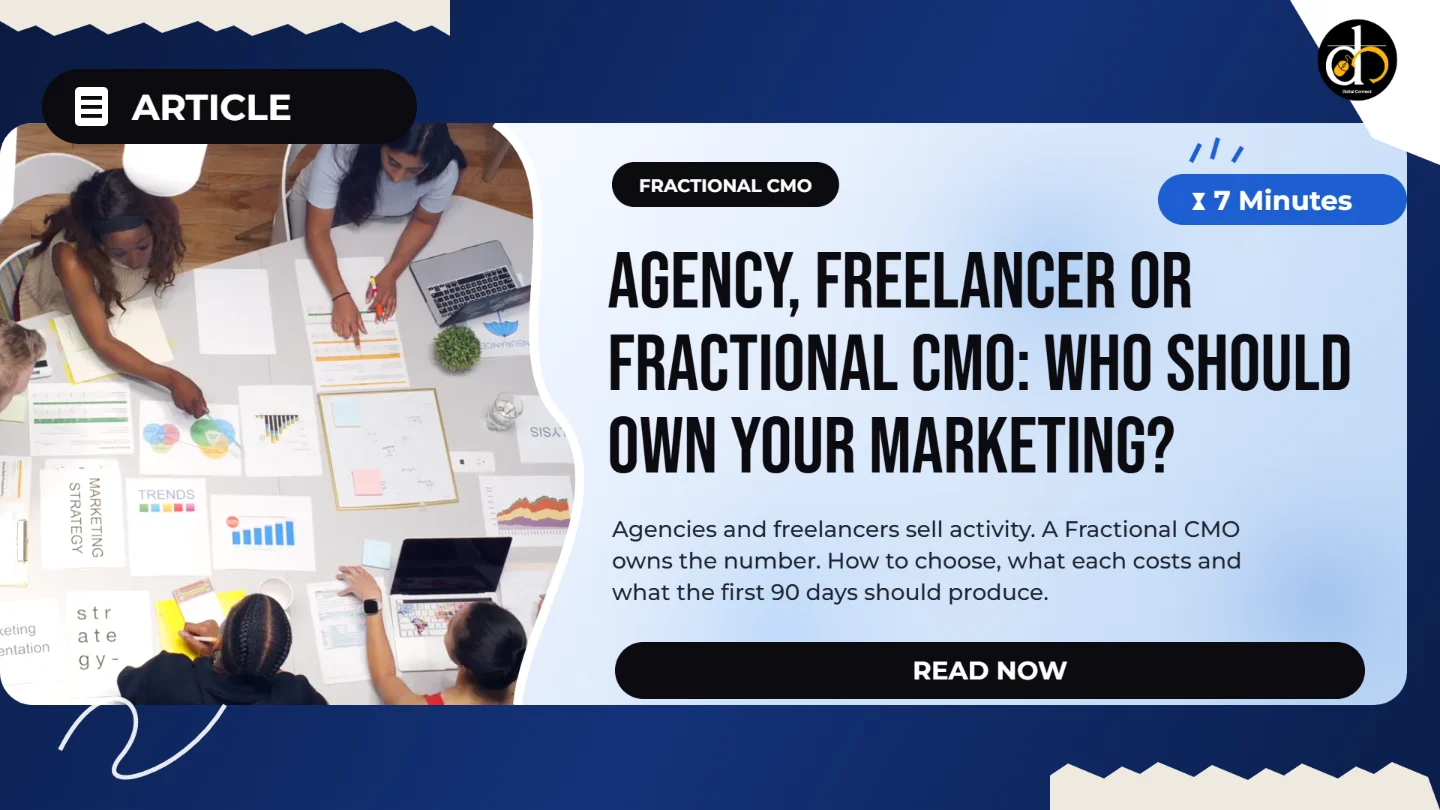
Agencies and freelancers are paid to produce work. Someone still has to decide which work matters and judge whether it paid off. In most growing businesses nobody does, and that is why spend rises while pipeline stays flat.
Part 1 of the Who Owns Growth? series on when to hire a Fractional CMO. Updated 3 November 2026.
In brief
- Hire for ownership of the marketing number first and for activity second. Agencies and freelancers are paid to produce work; someone still has to decide which work matters and judge whether it paid off.
- In most growing businesses that someone is the founder, fitting marketing between sales calls. That gap, rather than the agency or the freelancer, is usually why spend rises while pipeline stays flat.
- A Fractional CMO fills the ownership gap for a fraction of a full-time salary and then directs the agency and freelancers you already pay. It is a sequence, not a replacement.
Why does marketing underperform even when the agency is busy?
Ask a founder why marketing isn't working and the first answer is usually the agency, the ads or the content. Push a little further and a different picture appears. The agency is delivering what it was briefed to deliver. The briefs came from the founder, written quickly between other priorities. Nobody set a target for qualified leads or cost per customer, so nobody can say whether last quarter was good or bad. And nobody set that target because nobody in the business owns the marketing number the way the head of sales owns revenue.
Traced to the root, the problem is rarely the quality of the people doing the work. It is that the work has no owner. An agency left to manage itself will report on what it controls, such as impressions, clicks and posts published. That isn't bad faith. It's what happens when the client never defines success in commercial terms.
Tighter budgets make this more pressing. Gartner's 2025 CMO Spend Survey of 402 marketing leaders found budgets flat at 7.7% of company revenue, with 59% of CMOs saying they lack the budget to deliver their strategy and 39% planning to cut agency spend. When money is tight, the businesses that grow are the ones that know which half of their spend is working.
What does each option actually buy you?
Agencies, freelancers and Fractional CMOs are often compared as three prices for the same thing. They aren't. Each buys a different kind of help, and the useful question is which kind you are missing.
| Agency | Freelancer | Fractional CMO | |
|---|---|---|---|
| What you buy | A team that executes across one or more channels | One specialist skill, such as design, ads, writing or SEO | Senior ownership of the plan, the budget and the result |
| Who sets direction | You, through the brief | You, task by task | The Fractional CMO, agreed with you |
| Who judges results | The agency reports on its own work | You, if you have time | The Fractional CMO, against pipeline and revenue targets |
| Typical commitment | Monthly retainer, often 6 to 12 months | Per project or hourly | A set number of hours a week, usually for 90 days or more |
| Works best when | Strategy is clear and you need volume of execution | You know exactly which task needs doing | Nobody owns marketing, or spend is rising without a clear return |
| Main risk | Activity without commercial accountability | Gaps between specialists that nobody connects | Hiring one without giving them authority over budget and partners |
Agencies and freelancers supply capacity; a Fractional CMO supplies judgement. Businesses that buy capacity before judgement end up with plenty of output and no shared view of what it achieved.
What does a Fractional CMO cost compared with an agency?
Costs vary widely by market and scope, so the most useful comparison is with a full-time senior hire. Built In's salary data puts total cash compensation for a full-time US CMO at about $293,000 a year. Go Fractional's rate data puts the median Fractional CMO rate at about $175 an hour for roughly nine hours a week, which Webtonic calculates at around $82,000 a year. On those US figures, a fractional engagement costs under a third of a full-time executive, with no recruitment fee or equity. Rates in India, the UAE and the UK differ, so check local benchmarks before comparing.
There is a second cost that rarely appears in comparisons. Spencer Stuart's data puts average CMO tenure at S&P 500 companies at 4.1 years, the shortest of the core C-suite roles. Smaller businesses that hire a full-time marketing leader too early often lose them before the strategy has time to show results. A fractional arrangement lets a business find out what senior marketing leadership is worth before making the full-time commitment.
How do you decide which one you need?
Four questions settle most cases:
- Can you name the person who owns your marketing number, and what that number was last quarter? If not, you need ownership before you need more execution.
- Is marketing spend rising while qualified leads stay flat? That usually points to a strategy and measurement problem, which an agency cannot fix from the outside.
- Do you already have a clear plan and simply lack hands? Then an agency or freelancers are the right buy, and a Fractional CMO would be overhead.
- Are you planning a full-time marketing hire in the next 12 months? A Fractional CMO can build the plan, the dashboard and the job description, so the new hire starts with a system rather than a blank page.
Can you combine them?
Most growing businesses should. The structure that works best in our client work is one senior owner directing a small set of specialists: a Fractional CMO sets targets and budget, an agency or in-house team runs the core channels, and freelancers cover gaps such as video or design. The Fractional CMO briefs the agency, reads its reports critically and decides what to stop, which is the part founders rarely have time to do well.
Authority has to be clear. A Fractional CMO who cannot change agency briefs, move budget or reset targets is a consultant with a title. Before engaging one, agree in writing which decisions they own.
What should the first 90 days produce?
A good engagement is judged by what exists at day 90 that did not exist at day one. At Dizital Connect we run three phases:
- Diagnose (days 1 to 30): funnel and pipeline maths, an audit of spend, channels, tools and partners, and interviews with recent customers and lost deals. The output is a written assessment and a ranked list of initiatives, with quick wins started.
- Decide (days 31 to 60): the ideal customer and message, a budget tied to pipeline targets (including what to stop), and one shared definition of a qualified lead for sales and marketing.
- Execute (days 61 to 90): two or three priority initiatives live, a weekly performance review, the sales handoff fixed in the CRM, and a 12-month plan with owners and budget.
At day 90 the business can continue at the same scope, expand it, or hand over to a full-time hire with the plan and dashboard already in place. In our experience, pipeline signals usually show by month three and revenue follows in months four to six, depending on the length of the sales cycle.
Frequently asked questions
Is a Fractional CMO just a consultant?
No. A consultant advises. A Fractional CMO owns outcomes, sits in leadership meetings, manages partners and is accountable for the marketing number for the agreed hours each week.
Will a Fractional CMO replace my agency?
Usually not. In most cases the agency becomes more effective, because it gets sharper briefs, clear targets and someone who reads its reports against business results.
How many hours a week does a Fractional CMO need?
Most growing businesses start at between 4 and 20 hours a week, with more time in the first month while the diagnosis is done.
Not sure whether your business needs capacity or ownership? Download the free 90-Day Growth Plan: a ten-question ownership check, the three-phase plan and a channel audit sheet that works out your cost per customer.







[…] and the result is what a Fractional CMO does, for a fraction of a full-time salary. We wrote up how to choose between an agency, a freelancer and a Fractional CMO, including what each costs and what the first 90 days should […]
[…] The marketer isn't the problem. The job was designed for five people and handed to one, with nobody above it owning the plan. If you're deciding who should own that plan, we compared the options, and what each costs, in Agency, Freelancer or Fractional CMO: Who Should Own Your Marketing? […]
Comments are closed.