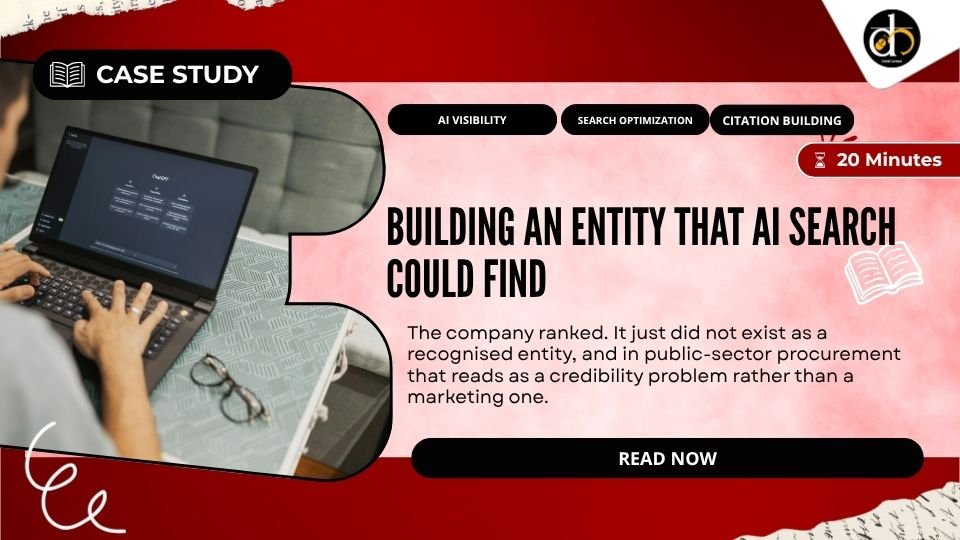
The company ranked. It just did not exist as a recognised entity, and in public-sector procurement that reads as a credibility problem rather than a marketing one.
Measured outcomes
1 January 2026 to 30 June 2026 · confirmed by the client marketing lead [SAMPLE DATA — replace before publishing]
| Metric | Before | After | Source and window |
| Branded search impressions, monthly | 4,200 | 6,100 | Google Search Console, branded query filter · Jan–Jun 2026 against the preceding six months |
| Sitelinks returned on branded search | 2 | 6 | Manual SERP capture, three-market sample · Verified 30 June 2026 |
| LinkedIn cost per qualified lead | $180 | $110 | LinkedIn Campaign Manager spend against HubSpot qualified-lead stage · Jan–Jun 2026 |
What the client was dealing with
A global provider of cloud-native, AI-powered emergency communication and call-handling software sells into agencies replacing legacy 911 infrastructure. Those are procurement-led buying committees who research a vendor privately long before anyone fills in a form.
The company had rankings. What it did not have was an entity record. Branded searches returned no Knowledge Panel and almost no sitelinks, so a buyer checking the vendor’s legitimacy found a thin result where an established supplier’s profile should have been. The team had been treating this as an SEO scoring problem. It was a recognition problem, and the two need different work.
| Pew Research Center tracked 68,879 real Google searches and found users clicked a traditional result 8% of the time when an AI Overview was present, against 15% when it was not. For B2B technology queries, AI Overviews now trigger on the large majority of searches. Pew Research Center, 22 July 2025. Trigger rates from aggregated 2026 industry tracking. |
How the engagement ran
01 Discover
Mapped the commercial goal, the buying committee, the existing stack and the baseline. Recorded what branded search returned across three markets before touching anything.
02 Diagnose
Rankings were adequate; entity resolution was absent. Schema, third-party profiles and authoritative mentions were inconsistent, so nothing consolidated the company into a single record.
03 Design
Built the entity architecture, the answer-first content plan, the paid channel role and the measurement model, with metrics and sources agreed in writing before work started.
04 Deliver
Aligned schema and sameAs references, corrected listings and citation sources, published answer-first content, and ran LinkedIn against target buyer roles while the entity work matured.
05 Develop
Supported the HubSpot integration so lead data landed in one place, then documented the workflow and trained the internal team to run it.
06 Demonstrate
Reported against agreed KPIs with baselines and windows attached to every figure, and used the evidence to set the next cycle’s priority.
Client quote
[REPLACE] Two sentences from the client: what was broken before, and what changed. Name, job title, company or description if anonymous.
Engagement detail
| Field | Detail |
| Sector | IT & SaaS · Emergency communications |
| Market | United States, public sector |
| Duration | Six months, entity results visible from month three |
| Services | Entity and AI search visibility, technical SEO, content, LinkedIn paid, CRM enablement |
| Systems | Search Console, GA4, HubSpot, LinkedIn Campaign Manager |
| Handover | Documented workflow, internal team running independently |
Not sure whether your problem is ranking or recognition
Most teams diagnose one and spend on the other. A short diagnostic tells you which constraint is costing you pipeline.
Client anonymised at the client’s request. Figures drawn from the source systems named above, against a stated baseline and date range.